Friday, 6 November 2015

Wanaka - Snow and Mountains

Last Wednesday we woke to grey skies and heavy clouds hanging over the mountains.  And it was cold, icy cold.

Brian lit the slow combustion burner, and before long it was cosy inside.  And the mountains were breathtakingly beautiful outside.  
Such a marvellous view from the front rooms of the house.
As the morning progressed, the weather warmed up, and the clouds cleared.  Then it was off to do a little shopping and to look at the recycling depot at the local rubbish dump.
It was very impressive.  As well as the usual recycling areas for cardboard, bottles, garden rubbish etc, they also sold wood, metal, bicycles and other goods that had been left there.

There was a huge shed which sold furniture, household goods and clothes.   So much choice.   A marvellous idea.
As the day progressed, the snow thawed, and soon there was only a smattering of snow at the top of Roy's Peak, on the opposite of the lake.
The township of Wanaka, such a peaceful place.
A beautiful day for a walk.
The bright clear sunshine lit up the house in the photograph below.  There was wisteria hanging from the wall beside the house and bright flowering shrubs at the side.  Stunning.
The day ended with a clear sky, and a promise of a heavy frost.   Not good for all the tender spring plants.
Wanaka, surrounded by mountains.  Such a beautiful place.

Wednesday, 4 November 2015

A Wanaka Trust Garden

Yesterday we woke up to rain, beating down on the roof.  Another wet morning, in late spring in the southern hemisphere.  But we are in New Zealand, and heading south.  However in Wanaka, according to Brian, it never rains, and he is correct to a point, as the rain generally swirls around the mountains.

First stop, the golf course.  Brian and Walter, posing with umbrellas, behind Brian's concrete post sculpture. placed there to stop people taking a short cut across the corner.  Looks very effective too, amongst the grasses. 
The second stop.   A garden that has been accepted  by the New Zealand Garden Trust.   The owners, now in their eighties, used to have a plant nursery on this site.  They now spend their time collecting plants and developing their garden.  Consequently they have many rare plants growing in their garden.

Luckily it had stopped raining when we visited their garden, so we could wander around slowly and without umbrellas.

A beautiful array of bright azaleas.
There are three streams in the garden, all coming from springs, either in the garden or nearby.
A family of ducks.  So cute, but I hope they keep away from the large ginger cat that was not too far away.
There are large native trout in the stream, skulking under the clear water.
Steps leading away from a spring fed waterfall.
Thick growth.  The garden is covered with plants, shrubs and small trees.
A grotto.  A small spring fed waterful.
Such magnificant rhododendron blooms.
And bright white flowers.
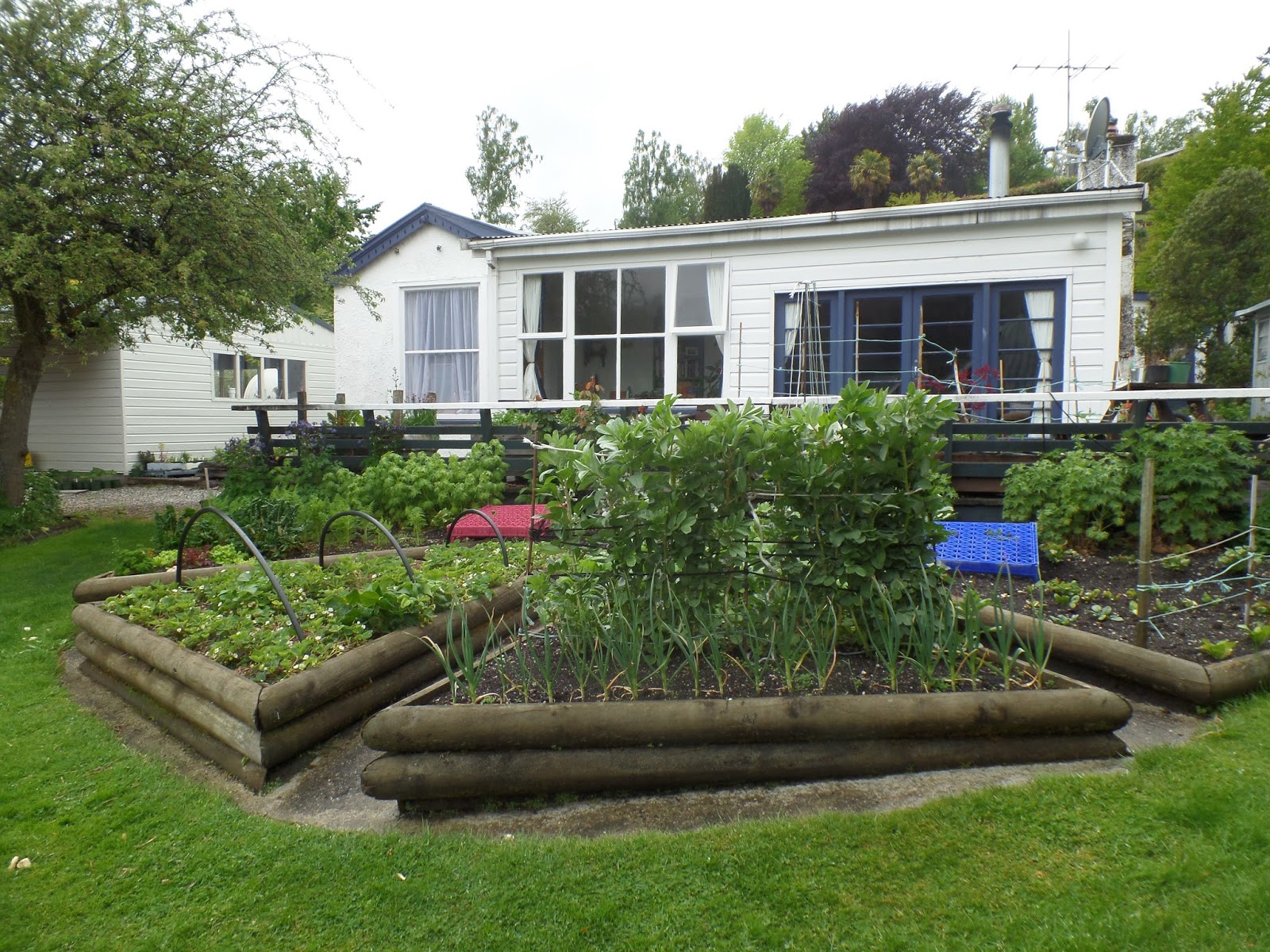
The raised and well organised vegetable garden, in front of an old cottage.

I apologise to those people who are knowledgeable about plant names and rare plants, as I have not included any plant names.   However I enjoyed the gardens immensely, as an amateur.

Tuesday, 3 November 2015

Rugged Westland, New Zealand

After a very restful sleep, we woke to the sound of crashing waves on the shore, which turned out to be heavy rain on the corrugated iron roof.  No high tides or stormy seas, just solid rain.   Very depressing.

First stop, the sock factory, which still produces socks, with hand dyed wool.  Very expensive at $40 a pair.   

Skeins of colourful hand dyed wool.  The finished socks are on the wall on the left of the photograph.  
The knitting machines still in use in the factory.
A small sock knitting machine.  These machines were used by people in their homes, in order to earn some money.  A cottage based industry.
Another piece of machinery used in the home - a knitting machine.  It was possible to knit a jumper in an evening.
At first we could not see anything, other than the road ahead.   The clouds hung low over the moutains and the rain fell relentlessly.  This was going to be a very wet trip, with no views of the rugged mountain terrain.  We once had an argument about the rugged scenery, the first time Walter drove through the Haast, as he could only see the bush at the side of the road.  No mountains, no peaks, no dramatic steep cliffs.
And suddenly the rain stopped, the windscreen wipers were turned off, and the surrounding countryside looked so much better.  However it was very much Lord of the Rings countryside still, with the mist hanging low over the mountains.

New Zealand bush is so dense in some areas, to walk a few metres into it, could result in being immediately lost.  Impenetrable.
We drove over many, many single lane bridges.  Love them.
A picnic lunch in the sunshine at Bruce Bay, with its stoney beach.
The amazing views from one of the popular viewpoints.
The twisty roads, winding around the coast.
The long Haast bridge, with two passing bays.  An extremely wide river bed, which can be a raging torrent when in flood.
Haast is now a reasonably large village, which caters for tourists, fishermen and walkers, with a few holiday makers thrown in.  And millions of sandflies.

We followed the road alongside the Haast river, which was probably just a track used by walkers and four wheel drive vehicles 60 years ago.  Then the Haast Pass road was built, which opened up the lower part of the west coast.

The Haast river, with the mountains towering above.
The Gates of Haast, which look so tranquil in the photograph below, but building a road through here was a nightmare.  The initial bridges were washed away.   When it rains the water comes through the narrow ravine with a huge force.  It is also not the place to be when there is a landslide or when it snows.
We followed the road up through the pass, then through some more bush, until we reached the edge of Lake Wanaka.  After winding around the edge of the lake we drove over the narrow strip of land which separates Lake Wanaka from Lake Hawea.
The high moutains towering above Lake Hawea.
Finally we arrived at Brian and Susanne's house.   It was lovely to see them again.

Now the rugged West Coast, wild and untamed, seems like a dream.  

Sunday, 1 November 2015

Hokitiki an interesting town on the west coast.

The day started early, at 5 am.  The Rugby World Cup finals, All Blacks versus Wallabies at Twickenham, United Kingdom.  A game that we could not miss watching, as we were visiting both countries.   And as I was born in New Zealand, I thought it wise to support the All Blacks, especially as I was watching it with my sister, Margaret.   And they won.  Great excitement and celebrations in New Zealand. 

After a restorative cup of coffee, we said goodbye to Margaret and Gordon, and set off towards the west coast.   It makes quite a change to travel south along this route, normally it is the other way around, that is from the south to north.  Already the scenery looks quite different.

First stop, our favourite tea rooms in Murchison, where we ate our hokey pokey (honeycomb) ice creams, although it was only 10 am.  Tradition cannot be changed, although the ice creams have diminished in size.  Just as well really, for the sake of our waistlines.
 We drove through Bullers Gorge, with the sides of the gorge on one side and the wide Buller River on the other side.  The fault line runs through there, with landslides when there is an earthquake.  We made a comment about hoping there would be no earthquakes today.  And we heard later there was one in the north island, and it could be felt in Nelson, not so far away.

We turned off the main road towards Westport, and drove through a very wide valley, which contained mostly farms, towards the small town of Reefton.  It was very pretty, with the broom and hawthorne out in flower.  Neither shrubs are native to New Zealand, and the broom has become quite a pest.  We noticed that most of the gorse had been sprayed, but it is an ongoing battle.   We can blame the first European settlers for bringing these plants to New Zealand.

After Reefton it was a very short journey to Greymouth, passing mining areas on the way.

Greymouth lived up to its name, as it was certainly very grey overhead, making the town extra drab and colourless.

A stop for lunch, and what better place than McDonalds.  First an ice cream and then a rubbish lunch.  In a land of excellent food too.  And we were not disappointed but the coffee was reasonable.

Walter walking quickly towards his lunch.  In anticipation, no doubt.   Actually his Angus beef hamburger was nearly acceptable.
 In New Zealand a large number of the bridges are single lane, with signs to let drivers know who has right of way.  It works really well.

The bridge in the photograph below also includes a railway line as well.
Then the town of Hokitika, only a few kilometres from Greymouth, on a very straight road.

Our motel room, not the Ritz I know, more like a chalet in a Butlins camp, but quite roomy and very clean.
 Hokitika, once the end of the railway line from Christchurch, with a bus service to the Fox and Franz Joseph glaciers, before the Haast Pass was built.  A wild west type of town. Now it is a modern community, with the main industry, other than tourism and jade and wollen sock workshops, being the milk powder factory which employs 500 people.

When the Maori lived here, they had a thriving community, and a plentiful supply of food which included a wide variety of fish plus sweet potatoes and honey. And a cultured life.

The first European, a man from Nelson, came here in the 1840s, followed by a huge wave of gold miners in the 1880s.  Hokitika grew into a large town, with the accompanying tradespeople following the miners.

We went for a long circular walk, which was very interesting.  Normally we drive through Hokitika quickly, in our hurry to arrive at a motel before it becomes too dark.

We walked along the beach, with its black volcanic sand, covered in drift wood, some of it being gigantic tree stumps.  The seas on the west coast can be very wild, and even on a calm day, it is easy to see the undercurrents and rips.   These seas are definitely not for swimming.
The pebbles, large and small, are flat, worn that way by the powerful seas.
Someone made a sculpture with some drift wood.  HOKITIKA.
Walter resting on an armchair.  A concrete armchair.  It looked at first as if someone had dumped an old chair there.
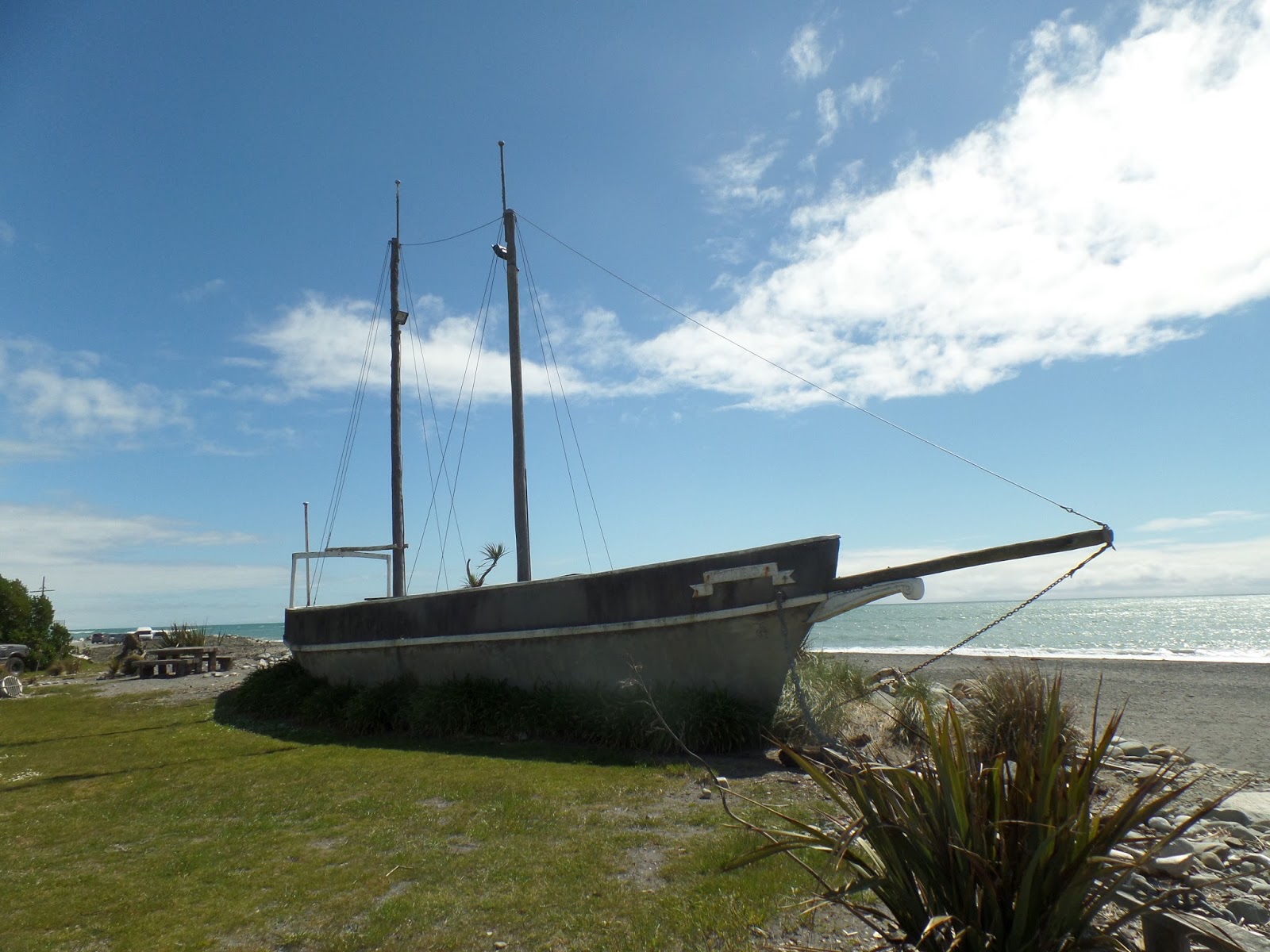
This was once a sailing ship which was washed up on shore.  Someone had salvaged some of the wood, and then made the remainder of the ship with concrete.  Inside the hull there were picnic tables.  Very inventive.
The spit at the end of the river, a very popular fishing spot.
I think that Mt Cook is somewhere there, in amongst the clouds.
The quayside, where, in the 1860s-1880s, there would be about 40 ships tied up.  The difficulty though, was trying to get the ships over the sand bank at the mouth of the river, and then negotiate the ships through logs and debris in the river.  Many ships sank, or were washed up onto beaches.  A very treacherous coast and river.
The huge baulks that hold the quay together are still visible, as are the bollards.  But trees and flax bushes now grow along the edge of the quay.
The piece of blue plastic, plus other bits and pieces, and the dog, do not belong to a homeless person (see photograph above). Rather it is the shelter for a person who is whitebaiting.  The nets are there but the person has left the dog in charge while he went for a coffee, I think.

The very wide streets of Hokitika.  Hardly a person in sight.  Noone interested in shopping in this town, although all the tourist shops were open.
The old customs building.
A roundabout, with the town clock in the centre.
St Mary's Catholic Church, a beautiful neo-classical building, which apparently took years to build, and now closed until the required earthquake strengthening work has been completed.  This will cost between $1,500,000 and $2,000,000.   It will probably be cheaper to build another church, which in many situations has already happened elsewhere.  Such a shame.
We ate a very healthy dinner, bought from the supermarket.  Plenty of salad, cheese plus yoghurt.

Hopefully we will have a calm night.  I have checked to make sure there is a hill close by, just in case of tsunamis or an extra high tide.  One can never be too sure.

Our motel is one street from the sea.