Friday, 13 November 2015

Blue skies and water plus mountains - perfection

We said our reluctant goodbyes to David and Catherine, and Lucy, the dog, and set forth on the last leg of our south island trip in New Zealand.

The sun was shining brightly and there was hardly a cloud in the sky.

The Clutha River in the photograph below was once a fast flowing river through a very narrow gorge.   The road wound around the edge of the gorge, and it was a spectacular journey.   Once the dam was built in Clyde the river rose, and became Lake Dunstan.   A new road was built higher up in the hill side.
The bridge over Lake Dunstan, at the new township of Cromwell.   The old town of Cromwell lies deep under Lake Dunstan.  Progress.
 A view over Lake Dunston, towards the mountains in the distance that surround Lake Wanaka.
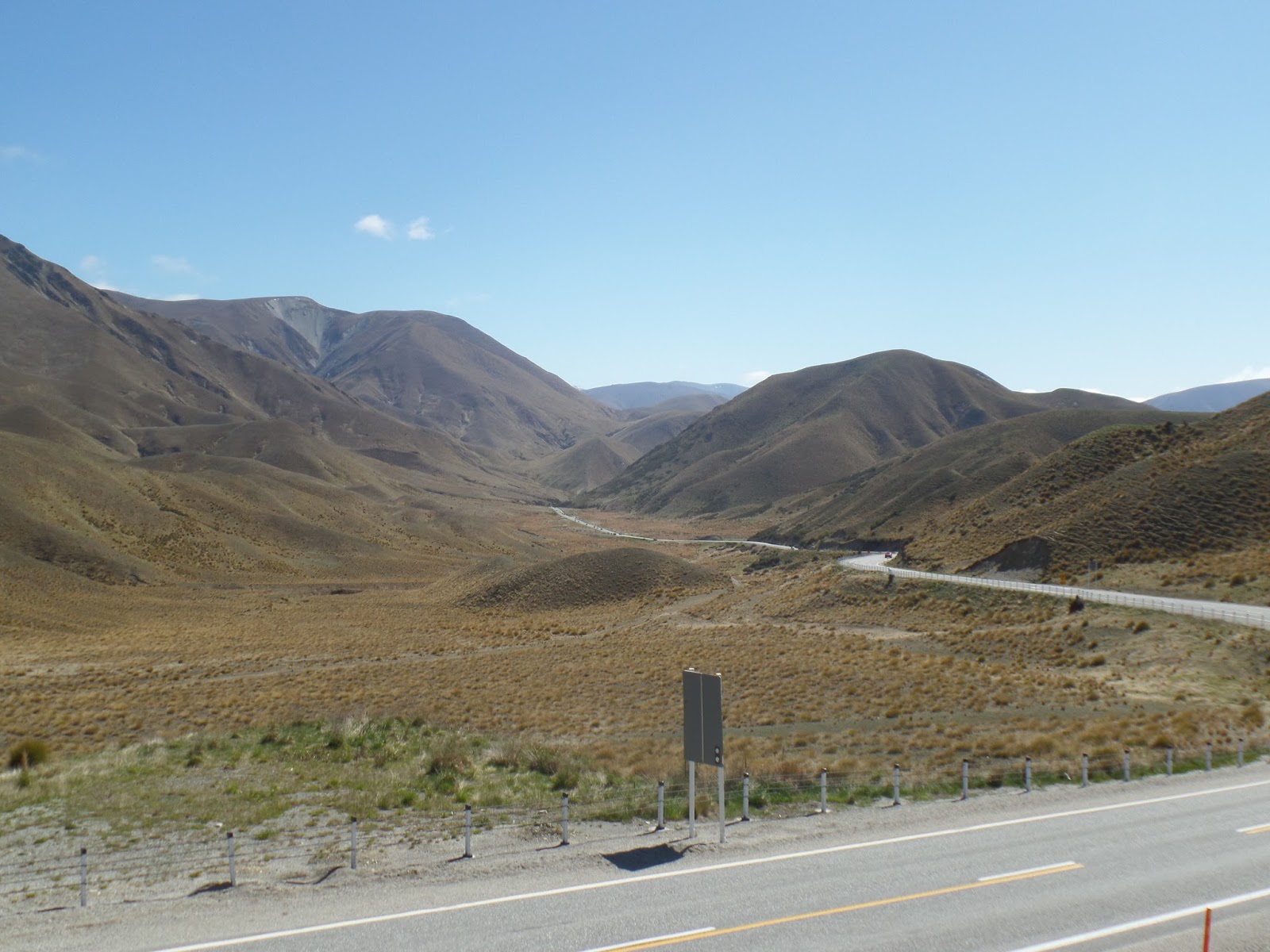
 We travelled through the Lindis Pass, pretty spectacular with its barren peaks and tussock grasses.
 Dry peaks and tussocks.  
 We drove past the cute little town of Twizel, and on to Lake Pukaki, with the high peaks of the Ben Ohau Range on the left.
 Then suddenly the high peak of Mt Cook came into view.  What a magnificant sight.  Often Mt Cook is covered in cloud, but not today.  We were so lucky.
 We stopped at the waters edge and took many photographs.
Such a perfect view to finish our holiday.  What more can I say!

A trip out to Patearoa - Central Otago

David and Catherine took us out for a short tour north of Clyde.  We drove alongside the Rail Trail, through Omakau and Ranfurly, before turning off the road towards Patearoa.   
We bypassed the turnoff to St Bathans, where there are small blue lagoons and a pub, complete with ghosts.  An old gold mining town, now mostly in ruins.  We had visited it a few years earlier.  We also bypassed Naseby, another charming town we had visited, which is home to a large curling rink.

The scenery was spectacular, with mountains surrounding us, as we drove over hills and through valley after valley.  
 
As it was spring the hills and valleys were very green.
There was still a little patch of snow on the mountains.
Roads rolled on, seemingly forever.
Now I am not sure why we visited Patearoa.   David did not know either, he just thought it would be a good place to visit, or he liked the name of the place.   The name certainly rolled off the tongue.

Well I can assure anyone reading this blog, that there is nothing at Patearoa now. However I think it might have been a busy and thriving town in gold mining days.  The remains of such a town were still visible plus a few gullies and hills where much digging had been done.

The place was deserted on the day we visited, the school closed in 2004, even the pub was closed.   A ghost town.

The war memorial, with one name on the WWI plaque, and about four names on the WWII plaque.   But well cared for, all the same.
The old store, now a house perhaps,
with a very fancy side gate.   A little incongruous, in such a setting.  Grand ideas, or rescued from a building, long gone.
The church, also a house, I think.
The hall looked as if it was used regularly, with a sports field in front.   And it was being mowed, all ready for the coming cricket season, perhaps.  A little bit of life there.
Aah, a bowling club.  It looked a little forlorn though.   Weekend bowlers?   Perhaps this was a weekend place, a haven from the hustle and bustle of city living.
The old bridge over a lovely little stream.  There was much evidence of gold mining here, with little hills and the remains of an old settlement.
So we drove a little further, into a huge dairy property.   Multi owners, probably overseas investors.   Just a trifle bizarre really.

The pieces of machinery were huge as was the milking shed, complete with a huge outdoor area with oversized lights.   What do they do with those cows?
So we left Patearoa, with many unanswered questions and returned to the more civilised Ranfurly.

Perhaps there might be something on Google about Patearoa.  And there is.  Used to be known as Sowburn, good golf course too, great for fishing, good for cyclists as it is not far from the Rail Trail and plenty of mud brick buildings.  That is amazing. 

Thursday, 12 November 2015

Clyde, Central Otago

A few very enjoyable days in Clyde, Central Otago, visiting David and Catherine.  Much warmer up there too, although it is bitterly cold in the winter, surrounded by all the mountains.
We went on quite a few long walks, and after all the delicious food we have eaten, it was also a way to work off a few kilos.

In the photograph below, Walter and Catherine watched David clamber up the old signals post on the Rail Trail.
As it was spring there were plenty of sheep and lambs around.
And vineyards.  Excellent wine growing area.   The Pinot Noir is one of the best I have tasted in that variety.
We walked from Alexandra to Clyde, 8 kms, on the Rail Trail.   There was once a railway line from Dunedin to Clyde, which closed in 1990, except for the section between Middlemarch and Dunedin.   The railway lines were removed, and it became a very popular cycling trail.   It covers a distance of 150 kms, with plenty of hotels and cafes along the way.   I think it takes about four days to cycle the whole way.

The railway platform at Alexandra.  The railway station was removed as it was falling into disrepair.
A few llamas, standing innocently in a paddock.  Such pretty faces but I believe they can be quite vicious.
David inspected an old truck, which was for sale.   Quite a lot work is needed to restore it though.   A task for a very keen person.
An old wooden railway bridge over a gully.  Sides were added to the bridge when the Rail Trail was developed, as no train would have been able to travel over this narrow bridge, if there were sides.   It was called Mutton Bridge as sheep were killed here during gold rush days, and sold to the miners.
The wooden sides and framework of the bridge.
The Rail Trail.
The thyme was out in full bloom.   Thyme was grown in Clyde at the end of the 18th century, and there was a substantial industry extracting the oils from it.  It has now spread everywhere, even up into the surrounding hills.
Walter, David and Lucy, the dog, walking along the track.
We also walked into the small township of Clyde, which has a number of very old buildings.

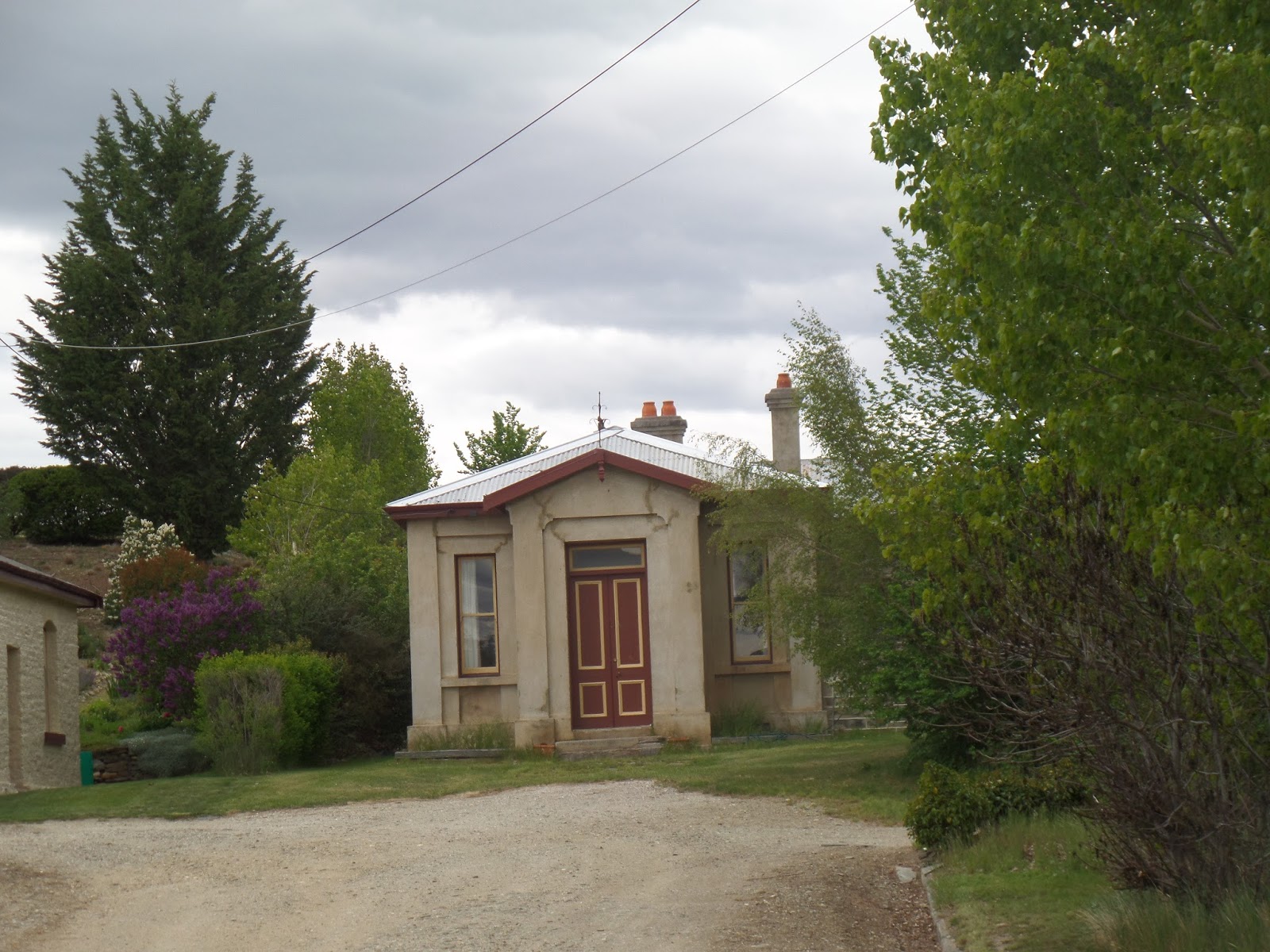
The old courthouse, now a private residence.
A very upmarket restaurant, cafe and boutique brewery, Olivers.   We ate a most delicious meal there on Catherine's birthday.
A wool shop.  Beautiful colours, and textures.  I could have spent quite a bit of money in that shop.
,
Yellow poppies, growing wild.  Very pretty.  Himalayan poppies we think.  Definitely not a native flower.
The dam at Clyde releasing some of its water, in a grand waterfall.
Very old stonework on the bridge below.
We also went for a walk along the Clutha River, amongst European trees.   One wonders where all the native trees and plants have gone.  No doubt removed by the first European settlers intent on making parts of New Zealand a home away from home.   It was a lovely walk, all the same.
One of the neighbouring gardens, full of roses and spring flowering shrubs. A labour of love.
Whitebait for dinner.  A New Zealand delicacy.   The whitebaiting has nearly finished, and people's nets have gathered plenty, although no whitebaiter will admit to this, in case someone takes their spot.   The tiny white fish are cooked in an egg mixture.   Delicious.
Brian came to stay the night, and it was lovely to see him again.  As well as the whitebait fritters Catherine cooked crumbed fish.  New Zealand fish is mouth wateringly good.
  
The twins together, my brothers, David and Brian.  No arguments either, not like the times when we were children.  Grown up people now.

Wednesday, 11 November 2015

Ranfurly and Ophir, Central Otago

After our little trip to the mysterious but empty Patearoa, we headed back to Ranfurly, much more civilised and very much alive.   An historic town, gold mining again, it is also home to the annual February festival commemorating Ranfurly's art deco heritage.  There are heaps of art deco buildings around the town, beautifully restored and well looked after.

The line up.  Walter, David and Catherine in front of the Ranfurly Hotel.
Ranfurly, was the lunch stop for the passengers on the Clyde to Dunedin train.  It is now a beautiful stop for the cyclists on the Rail Trail.

The old railway station, with garden in front.  An information centre and a place for weary cyclists to rest before continuing their journey.
The old tea room and milk bar, where hungry train passengers ate their lunch
The Rail Trail cycle path in front of the old railway station.
Inside the old tea room and milk bar there is now a small museum, with many interesting artifacts, plus a small area selling hand knitted garments, made by the local crafts group.   All for a very small price.  I bought a scarf and hat for $20.
We ate a most delicious lunch at this small cafe.  Very friendly people, as well.
The main street of Ranfurly
And then onwards to our next stop, Ophir.
Ophir is a tiny settlement, with heaps of personality and unaltered historic buildings.  It started off as a gold mining town in the 1860s, and at its height was the commercial and social centre for the area.  But then the gold dwindled and the railway line was put through Omakau, not far away.   Ophir more or less fell into obscurity, which probably saved its historic buildings, as there was no one to knock them down, or modernise them.

An old wooden store.   There was a small stall in front, with an honesty box, selling home made soap.  I bought one bar as I could not resist the beautiful citrus perfume of the soap.  I hope it works as well as it smells.
The old courthouse, now a private home.
The old post office, which still opens for three hours every day.  The most photographed building in the town apparently.
The rocks holding the iron roof down on one building.  Nails are perhaps short in supply there.  I would not like to be under the roof on a windy day though.
We loved the goat.  Very friendly, but then he was on the other side of the fence.
A most interesting day.