Tuesday, 20 October 2015

First stop - Singapore

Singapore.  Always good to be here.  It does not have the charm of other south east asian countries, and quite expensive, but it is very clean and well organised. 

The journey started well, with a pleasant couple of hours in a lounge at Heathrow, Terminal 2. Courtesy of our bank.   Very pleasant.
The plane trip also went well, thank goodness, as I was very nervous about flying long haul again after being so ill on the last flight.  As a precaution I carried with me a bag full of tablets, and ate vegetarian food.  But Singapore Airlines was a fast improvement on the Malaysian Airlines flight.  Spotlessly clean, very hygenic and choices of food.   They gave lots of goodies out,  socks, eye masks, toothbrushes, ear plugs and earbud phones, plus there were touch screens and a huge array of movies.  And not to forget the hot towels.   Interestingly, as it was a smaller plane over half of the plane was filled with first class, business class and economy plus.  Those of us in bog standard economy were in two sections at the back.  But we were comfortable, all the same.  

Cheap black fluffy socks from Primark, very warm and comfortable, but not the most sensible to wear on a plane.   Black fluff everywhere!

Singapore Airport, quiet, hushed, highly organised and very clean.
As we were being driven to the hotel in our taxi, I could not help but reflect on the changes in Singapore.  A city where 42 years ago we drove our zippy MG Magnet around, whilst avoiding using the dodgy second gear.   We knew most of the high rise buildings, as there were not many.  But now we recognise only the street names, still so very familiar, but the city has completely changed, and changes every time we come here.  A very modern city, cosmopolitan, efficient and highly technical.

Our first coffee at the hotel.
We are staying at the Village Hotel Albert Court, a very pleasant hotel built around old Singapore shops.   Great atmosphere as it has retained some of the old Singapore,  but greatly modernised.

The road in front of the hotel has been pedestrianised, so much more relaxing.  The old shops are now restaurants, with outside seating areas.

I think Walter had thoughts of taking me for a ride on a trishaw.
The only vehicles that used the short road, dropped off passengers at the hotel.
A view of the hotel, with the old shops incorporated into the building above.
The area around the hotel, if our memories were correct, was once a second hand goods market.  We called it  'thieves' market', as many items were probably stolen.   The rumour was that you could buy back any goods that were stolen from you.  It was a great place to fossic for antiques.

As we walked along the wide pedestrianised road towards Bugis Street, we stopped at a food hall, for lunch.  A very interesting lunch.  A chapatti with a vegetarian filling and rolled up in paper.  We were not sure how to eat it as it came apart as soon as you took the paper off, so we put it on our plate and spooned some curry juice on top.  Delicious.

I look very jet lagged in this photograph.
Ah, Bugis Street, now the home of markets, with a great shopping centre at the end, after Victoria Street.  There were always markets here during the day, but at night Bugis Street took on another persona, a little more colourful, lets say. At night Bugis Street was the place of bars, drunk sailors and soldiers, and interesting men/women.  The toilets were known as the venue for a certain dance, called the dance of the flaming a.....  Drunk sailors would stand on the toilet roof,  put rolled up newspapers in their bottoms and light them.
After a walk around the shopping centre we walked back to our hotel along the pedestrianised road.  Very pleasant.
Great to be here.

Friday, 16 October 2015

Off to a warmer climate, down under.

Off to a warmer climate, destination,  Singapore, New Zealand and Australia.  Well the south island of New Zealand may be still a little cooler, as it will be mid Spring.  But there will be longer daylight hours, and a promise of summer ahead.

We have cleaned the house, tidied the garden, and packed our bags.    Nearly ready to leave. 

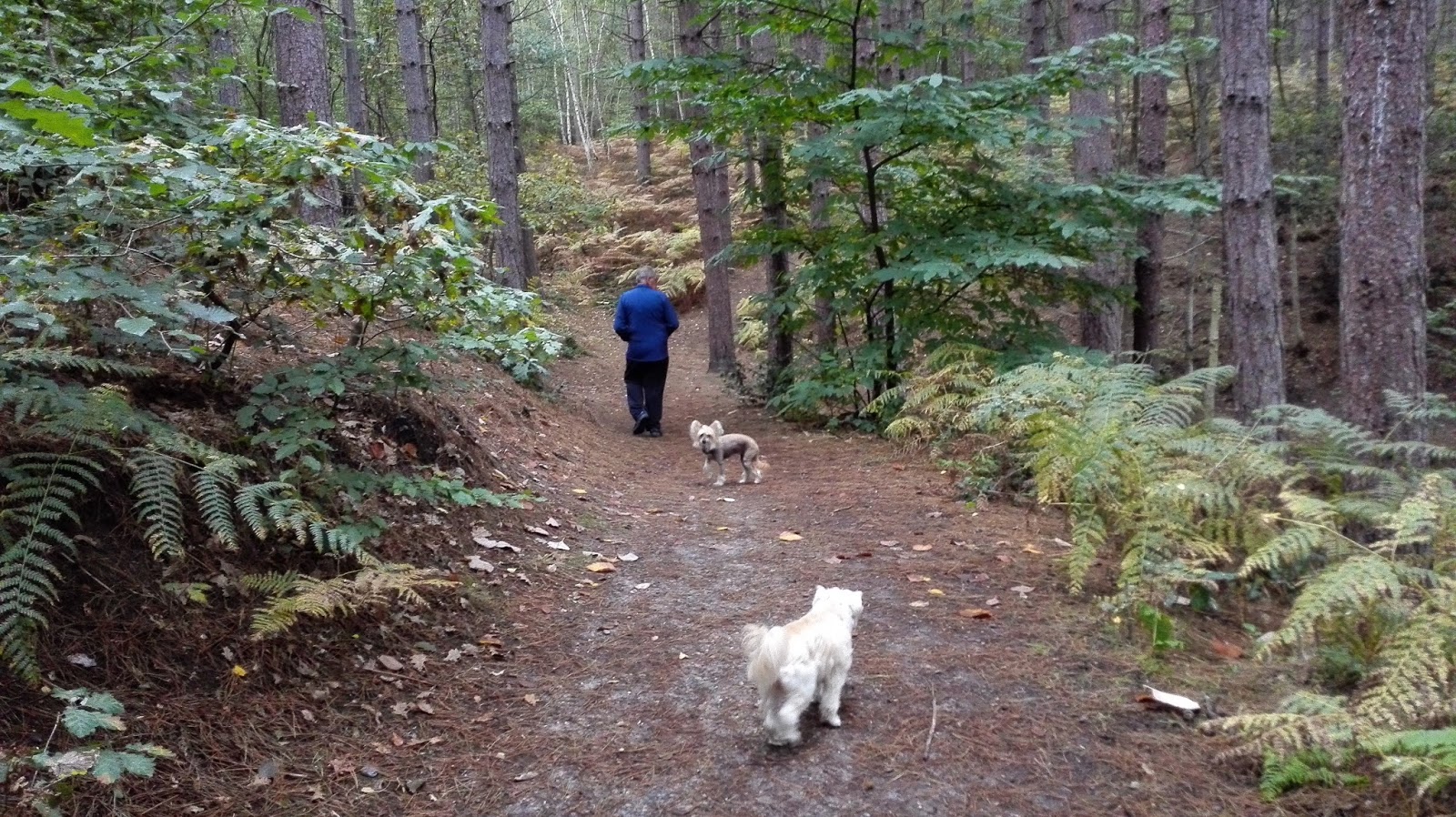
Today we went for an autumn walk with Bobbi and Jezzie, in the autumn mist and gloom of Joydens Wood.  The wood has its own magic at the moment, with leaves changing colour and dropping onto the ground.  The acorns and chestnuts are also dropping to the ground, and the dogs were not impressed with the prickly chestnut shells.  I will miss the woods as they change from their autumn colours to winter starkness.
I know I will regret not raking the leaves up from the lawn before we leave, but the tree has not finished shedding them yet.  I noticed today that the mole was having a good cleanout of its tunnels.  Best to forget about it all until we return.
 Margaret has sent me some beautiful photos of spring flowers in Nelson, to give us something to look forward to next Friday.
We will miss everyone here during the next few months but looking forward to seeing family and friends in New Zealand and Australia.

Thursday, 15 October 2015

Museum of london

A quick trip into London, in order to visit the Museum of London.   We have been meaning to visit this museum for months, but it has not happened, so we decided that Monday was going to be the day.

We caught the train into Cannon Street, the Circle Line to Moorgate, and walked around the building sites, including work on the Cross Rail.    Finally we arrived at the Museum of London, which was beside the London Wall.

A photo, taken through a window of the museum, of the old Roman wall.
The museum takes the visitor through the centuries, from the earliest possible times, 450,000 BC, until now.  All exhibits and explanations were clearly set out, and it was a pleasure to move through the different rooms, displaying the history of London.

I think the photograph below, was of a shop window, in the Victorian Walk.
A gas light.
Another shop window in the Victorian Walk.
A reinactment of the Vauxhall Pleasure Gardens.
The Lord Mayor's State Coach, built in 1757, and still used today in the annual Lord Mayor's procession.
A lovely garden at the entrance of the museum.  
We decided to walk back to Cannon Street, as we thought it would be quicker than trying to walk to the nearest tube station.   And we were correct.   It was also far more interesting.

A view along the street, with a church spire in the distance.
St Pauls Cathedral looking very majestic against the blue sky, and with the sun shining brightly on its walls.
The leaning tower of The Shard.   Why is it that my photographs of towers show them as leaning towers?
The last view of the skyline of London, as we approached London Bridge Station.
The Museum of London, which outlines the history of London, complements the Museum of London, Docklands, which displays the history of London as a port.   Both museums are free, which we all appreciate very much.   There was also a display at the museum about crime in London, which looked very interesting, but we thought would be just too much.   One can only take so much history in a day.

Wednesday, 14 October 2015

Rudyard Kipling and Bateman's House

Bateman's House.   Rudyard Kipling's home from 1902 until he died in 1936.    

It was due to watching a programme about Sussex and Kent, featuring Penelope Keith, that we found out about Bateman's House, set in the Dudwell Valley, and the nearby village of Burwash.   Consequently we were inspired, and wanted to visit the area ourselves. 

Bateman's was an old sandstone house, built in 1634, and made of local, traditional materials.   It had been left mainly unchanged during the centuries afterwards.   Kipling installed modern bathrooms and a kitchen, but left much of the interior as it was when he bought it.    He then filled it with old furniture. 
Rudyard Kipling was born in Bombay in 1865, attended school in England, and became a successful writer at a very young age, earning a considerable amount of money. He married an American, and lived there for a few years, before returning to England.   His two daughters were born in America, but sadly his eldest daughter died of pneumonia, aged only six years, during one of the visits back to America.   He also had a son, born in England, who was killed in WWI.    The deaths of two of his children affected Kipling greatly.

Kipling's daughter, Elsie, married Captain George Bainbridge, and they bought Wimpole Hall in Cambridgeshire, and lived there until they both died.   We visited this house, with Richard and Dawn, in July.

Bateman's House represented to Kipling, his ideal of English life.  It was also quite isolated, which gave him the peace and quietness, away from prying eyes.   He continued purchasing farmland around the house, for many years after the initial purchase.

The gardens surrounding the house are very extensive, and on a beautiful sunny day, quite stunning.
Inside the house, it was as if the Kipling's had just walked out of the house, and would return any minute.   A very spiritual place.

Rudyard Kipling's study, together with his private collection of books, and writing desk with all his writing materials at hand.
The view through the front gate.   A very simple lawn adorned the front of the house.
We decided to take the one mile, Ironmaster's walk, which circled the house and some of the farmland.

The very still and tranquil millpond.
The path took us over an old bridge.
At last we reached the area where once there were was an iron industry.    The industry began during Norman times, and continued for about four centuries afterwards.    The area was ideal for this type of industry, as there was a plentiful supply of iron ore, plenty of water, and a good supply of timber to provide charcoal.  

Once the production of iron finished the stone buildings were removed, and the woods grew back.
Apparently if one looks closely, which we did not unfortunately, there is tell-tale waste, or slag, from the smelting process, a few mining pits, and a faint evidence of a forge.

I think if we had spent more time in the area below, we would have found more evidence.   Missed a chance here, I think.
We had wonderful views of the Dudwell Valley.
A photo of some peaceful sheep.    I am pleased there were no cows though.   I find them a little threatening.
The village of Burwash, which during Kipling's time, contained twenty shops and about seven pubs.   It is definitely much quieter these days.

St Bartholomew's Church.   Inside there is a memorial to John Kipling, the son.
John's name is also written on the memorial.   The memorial has a lantern top, and candles are still lit, on significant days, to remember the men who were killed in WWI.
It was such an interesting visit, although it has taken me two weeks to write this blog!

Tuesday, 29 September 2015

Pevensey and its bay

We are actually between Norman's Bay and Pevensey Bay, even though the camping ground is called Norman's Bay Caravaning and Camping Ground.  And the area certainly has its charm, marshy, with shingle barriers between the land and the sea, but quiet at the moment, and bathed in sunshine. So peaceful.

About five minutes drive west is Pevensey Bay, which boasts some significant historical events.

In 1066, William the Conqueror landed here, when he invaded England, with his army of course. He then made his way inland and defeated King Harold and his army. One has to be careful to include their armies, otherwise it sounds as if there were only two men involved, William and Harold. 

In the 18th and 19th centuries, Pevensey Bay, became involved in the south sea smuggling trade.  Plenty of character building there.

Now it is a holiday destination for British people, plus some permanent residents living in low budget homes.   No tacky amusement arcades, thank goodness.  Just a very pleasant area, with a shingle beach.   
Lunch today was at Bateman's House, inland, but more about that in my next blog.  Great lunch, packed in our National Trust cooler bag, very appropriate for visiting a National Trust property.  
Pevensey, the village, is perhaps a little more upmarket than the bay.  Beautiful old buildings, and well preserved.

In Roman times Pevensey was a peninsula surrounded by a tidal lagoon and marshes, but the lagoon has now silted up, although much of the marshland is now a protected wildlife area.
Pevensey High Street, with the castle wall on the left.  We drove around the castle a couple of times yesterday, with the caravan, trying to find the camping ground.
Pevensey Castle, is now run by English Heritage.  It started out as a medieval castle and former Roman and Saxon fort.   It then fell into ruins but was rebuilt by the Normans after 1066.   During WWII it was occuped by the Home Guard, the British and Canadian armies and by the United States Army Air Corps.
Tonight we visited a pub in Pevensey, called the Smugglers Arms.   Great food, all freshly cooked.  Walter ordered lamb shanks, mash and vegetables and I ordered grilled plaice, new potatoes and salad.  Delicious.

Walter looking very happy.
It was great to see dogs in the bar, two beautiful black labradors and two fluffy highland terriers.  

We were also entertained by a large music group, as it was their practise night.  What more could one want.
But before I finish this blog I must comment on the friendliness of people here.  Makes such a difference to one's impressions of an area.  

Monday, 28 September 2015

Camping Norman's Bay

Camping Norman's Bay.  Not quite Camping Manjastre, in the Cote d'Azur, with its blue sea, and glitzy lifestyle, but more south coast rural England. Definitely more subdued.

But where are we?  Good question.  We had difficulty finding the camping ground today, as we did last time we were here, when we collected Jackson and Isabel from Emma and Steve when they were camping here.  As then, we made a few trips around Pevensey, and Pevensey Bay, trying to find the correct road, only this time we were towing a caravan, which made navigating the narrow roads all that much trickier.

And for those people who do not know this area, Norman's Bay is between Hastings and Eastbourne, on the south coast of England.  A flat, and seemingly isolated area, the road past the camping ground does not appear on our satnav.  The houses here are probably not at the high end of the housing market, an insight gained from reading the 'for sale' notices in the real estate office.

However, here we are, for a few days away, to ensure that we do not forget how to tow a caravan, and to make sure everything works after we had it serviced last month. 

And the sun is shining.  Makes such a difference.

The caravan and car nestled cosily together on the small gravel hardstanding, in amongst the lush green grass, still hard enough to drive on.
 Norman's Bay Camping Ground nestled among a few outlying low hedges.  A very exposed spot on a cold and windy day.
 No sandhills here, just stones and more stones.  A view towards the town of Bexhill, and Hastings further behind it.
 A Martello tower.  They were built after the French Revolutionary Wars as coastal forts.  And there were plenty still standing on the south coast, some were made into historic monuments while others have been sold, and converted into very solid homes, with marvellous glassed in viewing areas at the top.
 I know I have a coat on, but in fact it was not really cold, just very windy.
 The sunset tonight was a fantastic show of yellow and orange, and made a great discussion point as we drank our evening apertifs, inside the caravan.  We are in England, after all.
Tomorrow we explore the local area plus a visit to Batemans, Rudyard Kiplings home.  Looking forward to it.

Thursday, 24 September 2015

Gardening or not!

Gardening or not!   Well I think it will be, not, except for a bit of weeding and cutting out of the old branches of the cultivated blackberries, plus getting rid of the rogue prickly blackberries that tend to spring up in the most inaccessible parts of the garden.   And I must not forget to level the side hedge, using our new electric hedgetrimmer, but I will need Walter's help with the job, as the trimmer is heavy.  Walter will hopefully be keen, due to machinery being involved in the task.  But any massive cutting back of shrubs, trees and hedges will have to wait until we return at the end of January, as the leaves will have barely fallen when we leave in three weeks time.  And I need the branches to be bare of leaves, so that I can see what I am chopping back.

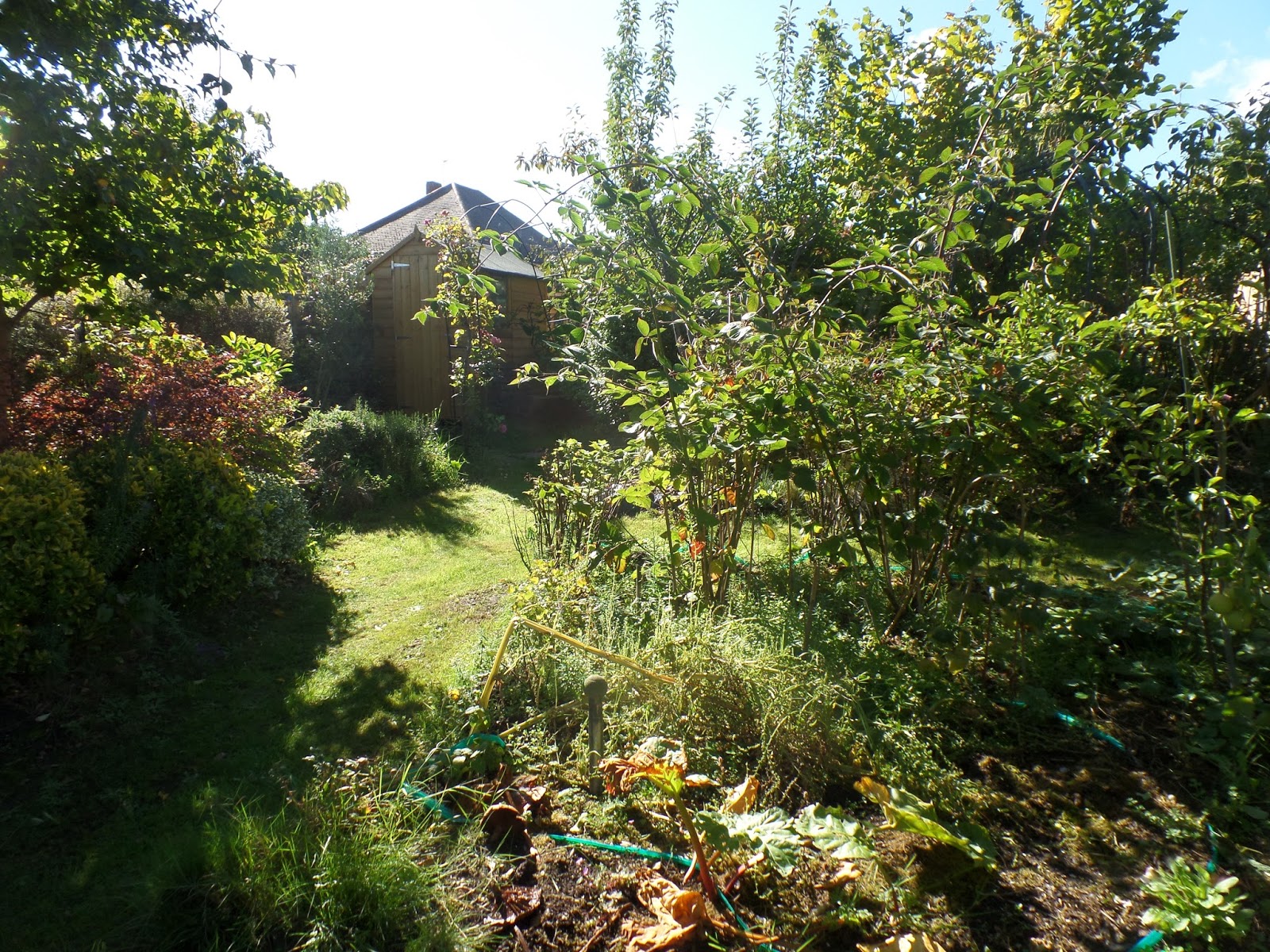
So I will ignore the overgrown garden,
and the mole activity.   It would appear that Mr Fox has been trying to dig down to find Mr Mole.

When Walter scooped the dirt off the next mole hill he found the entrance to the tunnel open.   Perhaps Mr Mole had been trying to escape Mr Fox.   The nightly activity in our top garden.

The garden looks much better when the sun is shining, so one can ignore the weeds,
and get out the sunlounger.   Why waste such beautiful sunshine.
However I did trim the bushes, ivy, prickly plants and spider webs back from the side of the steps.  Just so that I can get up to the garden without getting wet, scratched or caught in a myriad of webs.
But I am just a little envious of the immaculate garden behind us, viewed through the trellis.