Monday, 7 December 2015

Western Highway to Adelaide

The temperature overnight in Horsham, Victoria, was a chilly seven degrees, but we woke up to brilliant sunshine.  The promise of a good day out on the road.  Very straight roads, with acres of golden crops on either side of the road.
First stop, Nhill, another deserted looking town.  So sad when the heart goes out of these once vibrant country centres.  But perhaps Nhill was still holding in there.   There were two prosperous looking cafes, and certainly the coffee was very good in the one we chose.

Nhill also had three pubs, all thriving, by the look of them.
A deserted street, with many empty shops, and those that were open were old, with dimmed lights.
A street of old shops.  Great character.
A beautiful lawn, and picnic area in the centre of two very wide streets, and spotlessly clean toilets, which included piped classical music.  A nice touch.
A very ornate and successful looking gift shop.
And then ever onwards, through other small settlements, past dry countryside, until we came to Bordertown, the unoriginal name of the town on the border of Victoria and South Australia.

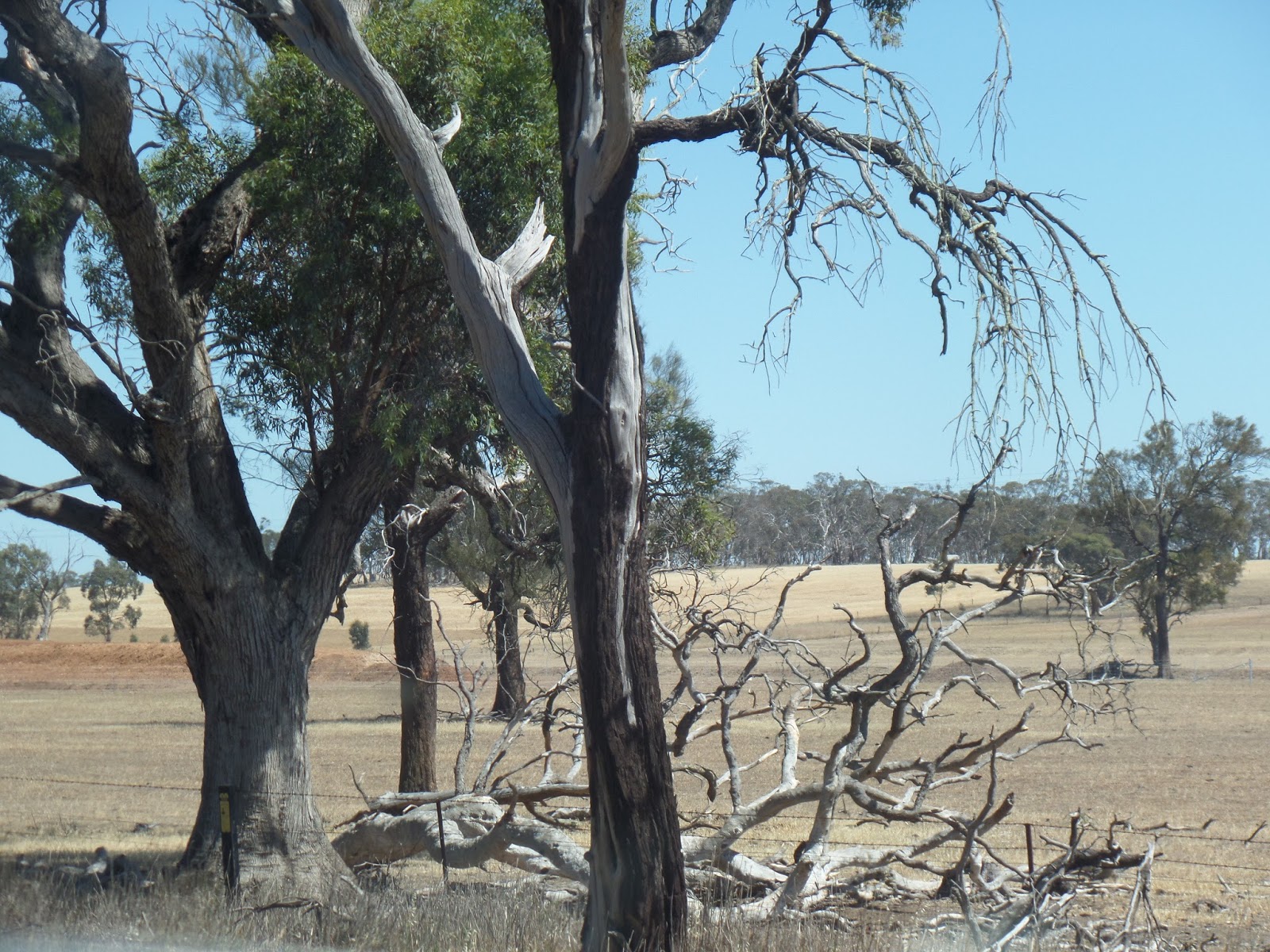
The photograph below is of the dry countryside, rather than Bordertown, which is quite a reasonable town.  An oasis amongst the brown.
Next stop, Keith, for our last picnic lunch.  Another green oasis.
A local tourist landmark.  The big jeep, up a pole.
During our trip through New South Wales, then Victoria and now South Australia, the huge grain silos dotted the landscape.   Hundreds of them.
Another iconic scene, the huge metal windmill beside the metal tank.
On through Tailem Bend, where we saw the River Murray, before it entered Lake Alexandrina, and the Coorang, and finally the sea.   The next time we saw the river was at Murray Bridge, before we started on the expressway that passed over and through the Adelaide Hills.

We finally arrived in Adelaide, a 2,700 kilometre drive from Merrimac on the Gold Coast in Queensland.

As we were collecting Donna from her work, in Adelaide, we decided to visit the Central Market, for a much needed cup of coffee.   The central market, one of the best markets I have ever seen, is absolutely full of food, of immense quality and quantity.
Walter enjoying his coffee, from Lucia's.   A long standing tradition for Walter, in the days when he visited the market each week, in order to purchase our fruit and vegetables.   The owner's daughter now runs the successful business.
Then it was time to collect Donna.  It was lovely to see her again, and all our other members of the family, who live in Adelaide.  Great to be here.

Friday, 4 December 2015

The Grampians

Off again, direction the Grampians National Park, an outcrop of volcanic ranges, and forest in Western Victoria.  An area that I have always wanted to visit, but have never done so.  Walter knew the area well, due to taking part in army training exercises there.

The roads after we left Geelong, were flat and straight.  It was a tad chilly, actually quite cold in fact.
First stop, at a small place, name conveniently forgotten due to the dreadful cup of coffee bought at a roadhouse, full of greasy food, sitting in trays awaiting sales.  A run down village, but probably once a thriving country centre.  Now all the shops are closed and empty,  including two cafes.  So the passing trade has to use the roadhouse.  I tipped most of my coffee onto a grass verge, but ate the stale cake.

There was a beautiful stone church with a dilapidated church hall, proudly opened at the beginning of the last century.  Times have changed.
The first glimpse of the range, rising above the flat ground.
A stop for lunch at Dunkeld, at the foot of Mt Sturgeon, at the southern tip of the Grampians.  A very trendy little town, with upmarket shops selling local produce, such as cheeses, hams, olives and grains.

However, the big road trains still came thundering through the town.  These big brutes are relentless in Australia.
When we turned into the Grampians the tall granite cliffs rose above us.

The road passed through blackened bush, with bright green regrowth.   The Grampians has suffered some huge bushfires over the years, and there are signs of past fires alongside the roads.   Bush fires are a natural phenomenon with eucalyptus forests.   They are natures way of regenerating bushland, but it becomes very difficult these days as people live in bushland areas.
Halls Gap, on the edge of the eastern side of the Grampians, is the tourist centre of the Grampians, and full of holiday accommodation, resturants, gift shops and cafes.  All situated among the trees, and very vulnerable to bush fires.

Walter enjoying a hokey pokey (honeycomb) ice cream.  They have this flavour in Australia now, so he is a happy man.
A very dry and stoney creek bed.
Some burnt forest with plenty of new growth, both on the ground and on the limbs of the trees.
A photograph from a high view point, overlooking ranges and Lake Wartook.
Hazy ranges.
Lake Wartook.
People made piles of rocks.  Happens everywhere.
We walked for about a kilometre, through the bush,
to see The Balconies, which are two ledges of rocks sticking out from the cliffs.  There were signs informing people not to stray from the path, however I saw an advertisement the next day, with a person standing on the lower ledge.  Not a great way to stop people from climbing out onto the ledges.
The gentle sloping valley, covered in bush, was an interesting sight.

The rocky outcrops.
It was a lovely walk to and from The Balconies.
I think this area, beside Mackenzie Falls, was burnt out in February, 2014.  We were meant to visit the Grampians then but bush fires were raging through this area.
The top of Mackenzie Falls.  We did not walk down to the bottom, as it was getting late, and we needed to get to our next destination, Horsham.
Recent new growth on the tall trees.
Finally we arrived at Horsham, on the Western Highway.  A bit tired but very satisfied with our trip through the Grampians.

Wednesday, 2 December 2015

Visiting Point Lonsdale

We spent a lovely few days with Rudolf and Connie at their home in Point Lonsdale, on the Bellarine Peninsula.   Point Lonsdale is a seaside resort right at the very tip of the peninsula, at the entrance to Port Phillip Bay, and the city of Melbourne.

As well as visiting Barwon Park, we also went into Geelong for a day of shopping.  Along the foreshore of Geelong, at Corio Bay,  there are amazing wooden figures.   I wrote a blog about them a few years ago, titled Corio Bay, I think.  But it is worthwhile looking them up on Google.  Unless you are in the fortunate position of being able to visit Geelong yourself.

Our visit this time was shopping trip.  And the photo below is for you, Isabel, your favourite shop in Bromley, was in Geelong.
The Myer Christmas window wool display.   The sheep moved to music.
Connie and Rudolf's garden was delightful, and on a sunny day one could sit out there for hours, which I did too.   A shadowy garden full of beautiful trees and plants.
I especially loved this sunny corner, partially shaded by the overhead shadecloth.
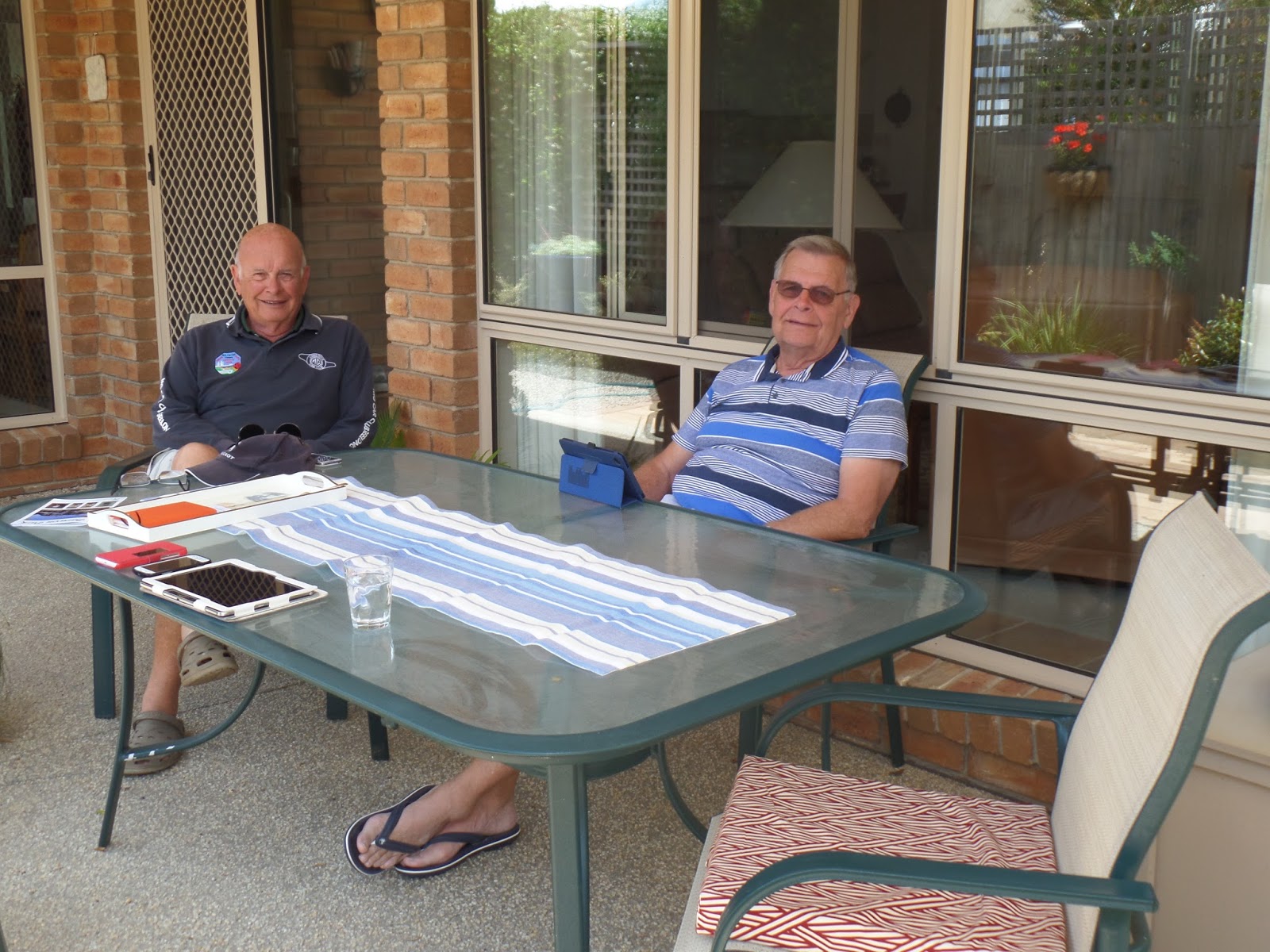
The brothers, Rudolf and Walter, sitting and chatting under the shady verandah.
We visited the old port of Queenscliff, now all tizzied up, and full of expensive yachts.  Always an interesting place to walk around, looking in the few shops and drinking coffee, at one of the many cafes.
The actual town of Queenscliff still retains its old buildings and character.  Lots of interesting little shops too.  Even the Vinnies charity store has an interesting array of second hand items.
A lovely old building.
We had a great time at Rudolf and Conny's house catching up on all the news, eating lovely meals cooked by Conny and indulging in a bit of red wine.

And now it is time to head west, final destination Adelaide.

Barwon Park

On Sunday, Rudolf and Conny took us for a visit to Barwon Park, in Winchelsea, Victoria.  It was a very imposing 42 room bluestone house, in the middle of farmland.  It was built in 1871 for the Austin family, on their very large farm.   Sadly, the husband, Thomas Austin, died within a year of having this grand house built.  However, his widow, Elizabeth, lived here for forty years.   Initially some of their children lived in the house also.  Elizabeth Austin was responsible for the building of Austin Hospital for the Incurables in Melbourne and the Elizabeth Austin Cottages for widows in Geelong.   
The grand staircase, with high ornate ceilings, an open landing at the top, plus open passages around the balustrades.
A view down to the front door.
The view up from the front door.  All very imposing and grand.
The area under the stairs was open.  I wonder how many bumped heads have occurred over the years.  People must have learnt the hard way to lower their heads as they walked under the stairs.
The huge dining room.  Interestingly the walls were plastered and then left without paint.  Over the years the plasterwork has developed interesting patterns and shadows.
An original loo, only two in the building.
A view over the flat farmland.   The land around the house was never developed or landscaped into formal gardens.  It stood alone in the grassland, except for a few garden beds at the front and a kitchen garden to one side of the house.   The wide shady verandahs looked over farmland.
An Aussie windmill, used for drawing water from deep within the earth.
The accomodation above the stables was reasonably comfortable.   Actually the servants quarters within the house were very comfortable.   I think the servants were well cared for, and there were many of them.
A little spooky. Ned Kelly hiding out.   Not really, just a figure lurking in the storage area above the stables.   Thomas Austin bred and kept blood horses, one of which won the Melbourne Cup.   He was well known for introducing rabbits into that part of Australia, and what a curse that has been to the land since.
The back of the house, with the two servant quarter wings above the service areas of the house.   After Elizabeth Austin, the house and some of the land was sold to the Batson family, who donated it to the National Trust, when the last member of the family died.
Winchelsea, the local town, came into being in 1854, before that it was known as Austin and then Barwon, as Thomas Austin owned all the land in that area.

The old council offices, which still displays shire photos and names, plus the beautiful window in the photo below, is now a restaurant, serving delicious foods.
We drove home via the beautiful beach suburbs of Torquay,
and Barwon Heads.
A very enjoyable and interesting day, despite the overcast skies and cold wind.