Wednesday, 15 June 2016

Rose of Tralee

The Rose of Tralee?  Not quite, as it is the wrong time of year.  The popular Rose of Tralee beauty pageant, open to all women of Irish descent around the world, is held in August.  In fact it is more like a five day festival.  And the town comes alive.

But in June, Tralee is very ordinary.  A county town that is more down to earth and engaged with ordinary life, rather than the tourist trade, according to the Lonely Planet.  And today I think we were the only tourists there.   The Lonely Planet also states that the town is dismissed as it is an overflow for Limerick and its social problems.  

And there were many gambling shops, old run down pubs, charity shops and Euro shops, plus quite a few people who had seen better days.
Aside from social issues, and people getting on with their lives, the centre of Tralee is quite pretty, with a lovely square and buildings that are well looked after.  Plenty of civic pride in the town.  My only complaint was the high number of cars in the centre of town. If the main street was pedestrianised it would be a perfect town to spend time wandering around and looking in the small shops.

The Kerry County Museum is excellent apparently, but we did not have time to visit it.

The beautiful Catholic Church, St John's, with its narrow spire.
The wooden rafters in the ceiling were most unusual.  I am not sure how old the church is, but there was a convent and school attached to the church.
We walked around the different streets, keeping an eye on the cars, when crossing over the roads.  They were all travelling very slowly.
Denny Street, with its elegant Georgian buildings.  This is the oldest part of the town.
The square, surrounded by pretty buildings.  We sat here and ate our ice creams.  The sun shone for a few moments.
I waited, and waited, and finally managed to take a photograph of this narrow street, witn only one car in it.
Another long wait between cars in order to photograph this beautiful pub.
Before I forget, the countryside is very well looked after in Ireland; no rubbish lying on the sides of roads or in car parks, the verges are kept trimmed, and people take great pride in ensurng their houses are painted and gardens are tidy.   Appearances do make a difference.

I bought the book 'Angela's Ashes' from a second hand bookshop today.  So I am all ready to catch up on the story set in Limerick.  Happy reading or not, as the saying goes.

Tuesday, 14 June 2016

A history lesson - Limerick

A very uneventful day.  No arguments or problems with the caravan.  And it only rained once.  The photos uploaded immediately onto Blogspot.  The sun even shone for a few hours late this afternoon.  

Wait, I forgot.  When Walter went to collect our washing from the dryer it was still wet, due to me not pressing the setting button.  The machine had been working on the 'cool' setting.  Still that was better than yesterday when I put both tokens into the slot for the washing machine, which meant that the wash cost €10 rather than €5.  Luckily the owner of the caravan gave us another token for free.  I always have problems with washing machines in camping grounds!

We visited Limerick today.  A very easy drive in, plenty of parking areas right in the centre of town, and a superb cup of coffee in a delightful little cafe.   According to the Lonely Planet there is quite a contemporary cafe culture in Limerick.

The Lonely Planet also said that the Limerick had an unfortunate nickname of 'stab city' but felt it was no more unsafe than any other urban Irish city.  I must say there were quite a few high fences around and locked gates.  

Limerick was also the setting for Frank McCourt's book 'Angela's Ashes'.  Apparently there were many people in Limerick who felt the book painted a negative picture of Limerick.  But I notice that there is a Frank McCourt Museum, and various places mentioned in the book are highlighted in brochures.  I must now read this book.

We initially walked along O'Connell Street, which appeared to be the main shopping street.   All the big name shops were there.

An interesting fact, if people are not already aware, is that Penneys actually is the same as Primark in other countries.  And Penneys/Primark is an Irish company with headquarters in Dublin. Arthur Ryan first opened Penneys in Dublin in 1969, and then opened four stores in England in 1973 but they could not trade under the name of Penneys because there was already a store trading under that name.  Hence the name of Primark. And Primark, for those people who do not have one in their town/country, sells clothes at the low cost end of the market.  A favourite shop with most people, although there are some who will not admit to shopping in Primark.

We looked inside the Penneys shop, and it was just as busy as our Primark, and just as packed with racks of clothes.  We resisted purchasing anything though.  Why carry clothes back to England, when I can have a Primark shopping spree there.
A lovely building on Patrick Street which is a continuation of O'Connell Street,

I am not sure if this building still holds a school or is an old convent.
But opposite the building in the photo above is the Cathedral Church of St Mary the Virgin.   An Anglican church of course.  As in the UK, the very old churches in Ireland were changed from Catholic to Church of England/Anglican during Henry VIII's reign.  It was quite a shock to learn that the English monarchy had so much power in Ireland.

The ornate gateway which leads into the church.
The ancient cathedral was founded in 1168.
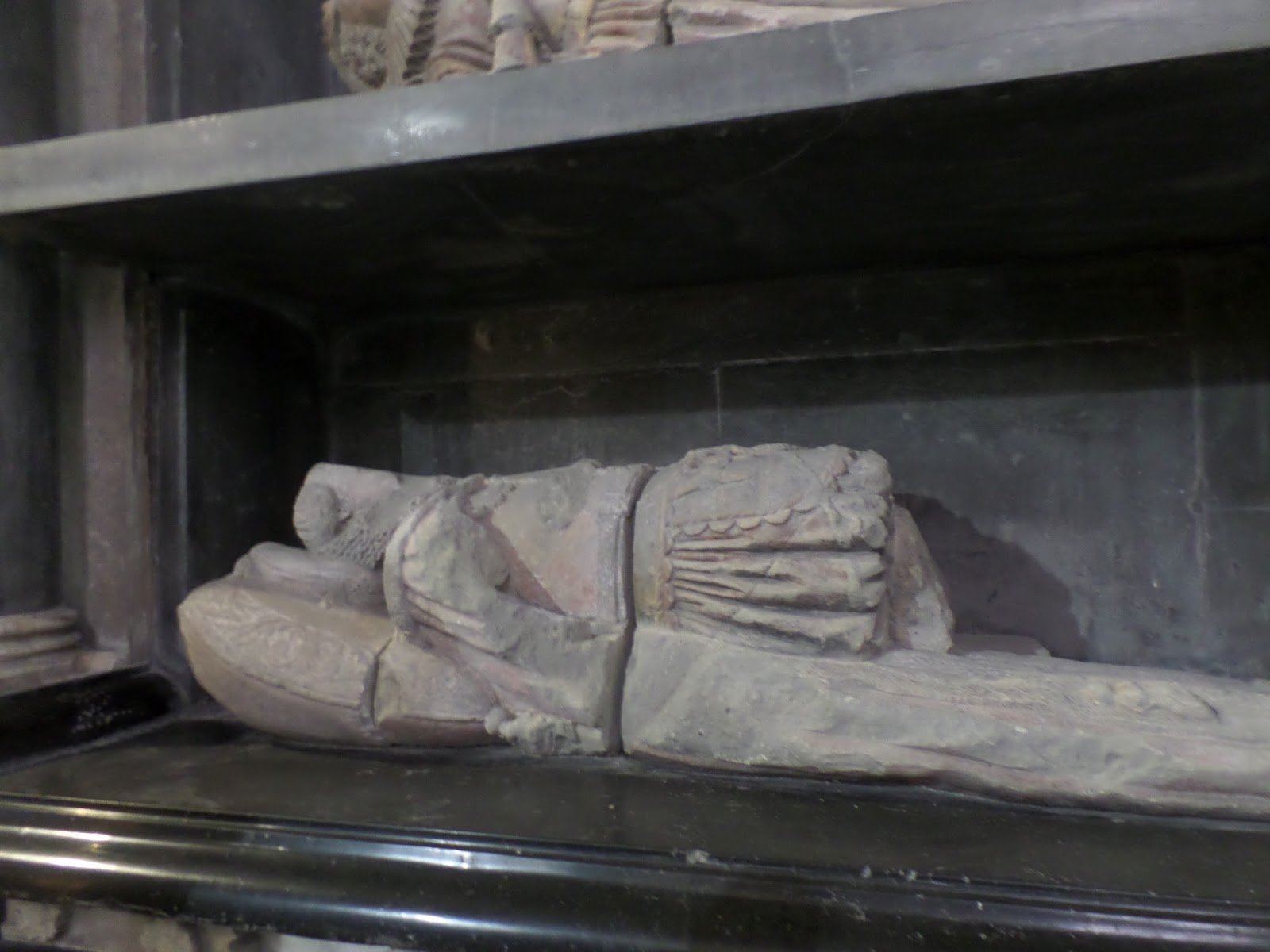
The cathedral did not escape Cromwell's desecration of churches.  His soldiers vandalised the church, and stabled their horses in it.  The effigy, in the photograph below, was damaged.
Finally we reached our destination,  King John's Castle, an imposing castle built on the edge of the Shannon River.

Limerick straddles the Shannon River, at the point where the river becomes the Shannon Estuary.  Viking invaders established a settlement here in the 9th Century, and fought with the local tribes over control of the land.  In the end the Irish won, and in 968 the O'Brien Kings ruled the area.

But this was shortlived.  By the 13th century the Normans had taken over the country, and had it was during this time that the castle was built.  The Norman's made Limerick into a Royal City.

The view of one of the towers.
A view overlooking the oldest part of Limerick.
The multi media display in the castle museum was excellent, as it told the story from early Gaelic Society, to the Norman occupation, to change and conflict during the reformation, to the sieges of 1642, 1651 and 1690/1691.  Very turbulent times.  Yet the Catholic Irish did not give up, even though the English enforced every increasing fierce anti-Catholic legislation after 1691, which was a betrayal as they had promised religious freedom for Catholics.

A view of the castle and bridge, from the quayside.  A huge number of the people from Limerick left by ship, from this quayside, destined for America or Australia.
Another interesting day, in a great city.  It is also fascinating to learn about the history of the Republic of Ireland, from an Irish perspective.

Monday, 13 June 2016

A snapshot of Co. Limerick and Co. Kerry

It was actually a snapshot of County Limerick, plus a tiny corner of County Kerry.

There is no doubt that away from Dublin, with its weekend focus on boozy gatherings, we are seeing Ireland at its very best; picturesque scenes, ruins,  beautiful countryside, good food and friendly Irish people.  

We set off early this morning to complete a circular tour in the car.  Our first destination was the scenic drive along the Shannon river between Askeaton and Tarbert.

The castle ruins in Askeaton.  The Hellfire Gentlemen's Club, built in 1740, and next door to the castle, is being restored.   Askerton is a very quaint village with plenty of interesting buildings, but we were too busy looking for a cafe, to stop and explore the place.
We found our cafe at the next town, Foynes, right next to the Flying Boat Museum.  Excellent coffee, and cakes plus an excellent museum.  Perfect.

The main street, docks and the River Shannon, viewed from the tower.
From 1939 to 1945 Foynes was the landing place for the flying boats that linked North America with the British Isles. Big Pan Am clippers would set down in the estuary and refuel.  It was a very exciting time.  After the war, Shannon airport was built and flying boats stopped flying to America.

The building in the photograph was used for accommodation for passengers.  Now closed.

We found out that Irish Coffee started in Foynes.   A flying boat had to return to Foynes, due to bad weather.  The passengers had been in the air for ten hours and were cold and feeling quite miserable.  The barman thought that they needed more than a cup of coffee, so added whisky and cream.   And a new drink was created in the process.
There was a replica of a B314 commercial flying boat.  This flying boat contained a 14 seat dining room, delux suite at the back of the plane and sleeping berths for all the passengers.  This flight was only for the rich, as a ticket from New York to Foynes cost $375.

Walter admiring the large flying boat.
Walter thought the seats were a trifle uncomfortable for a long haul flight, which took 13 hours to get to Newfoundland, and then there was another journey to New York after that.  But there was room to move around, huge washrooms, large cabins and the seats converted into spacious beds.
We drove on to Tarbert, and ate our packed lunches, while looking out over the Shannon Estuary.  We also watched the ferry that took passengers and vehicles from one side of the estuary to the other.

Behind us was a very large power station, not included in the photograph.
 On the way through the town we noticed a restored gaol which was a museum.  It also had a cafe, which I must admit influenced our decision to stop.  We needed our after lunch coffee.

The gaol was called the Tarbert Bridewell, and was one of about ten built in Ireland by the English during the 19th century.  They got their name from Bridewell prison in London.   This particular gaol was built in 1831.  The gaols were used for short term offences, anyone who received a longer sentence was sent to Tralee.

All offences were treated severly, and as most of the offences were due to impoverished people stealing in order to feed families, the punishments were harsh.  Many people were transported to Australia, for minor offences.

The displays and explanations in the museum clearly showed the harshness of the system.

Walter posing with the policeman on duty.
The man in the centre was caught trespassing on a farm.
The man's subsequent court case.  He received a 10 shilling fine.
The sentence that stayed in my memory was for the woman in the photograph below.  When her husband died she was left without any income, and seven children to support.  She was caught stealing two cabbages, and although she organised a petition so she could be released from prison, she was sent to Australia, together with her youngest child, a baby.  The remaining six children were sent to workhouses.  The baby died on the voyage to Australia, and the woman never returned to Ireland.  It was a one way journey. So very sad.
We needed our coffee after viewing the museum but it was well presented and quite powerful.

Our next stop was in the eastern part of Co. Limerick, a town called Kilmallock.  In the meantime we drove on aome very narrow and twisty roads through Listowel, Abbeyfeale, Milford and Charleville.  All looked great places to stop and have a look around, but no time.

A ruined castle alongside the road.  Not quite a ruin around every corner but there were plenty of them.
 Kilmallock.  An interesting small town now, but during the middle ages it was Ireland's third largest town, after Dublin and Kilkenny.  The town developed around a 7th century abbey and from the 14th to the 17th centuries was the seat of the Earls of Desmond.  Consequently this town has many ruins.

A 15th century tower house, which I think was the King's castle.
The abbey, partially restored.  A most magnificent building still, and it was quite daunting to walk around amongst the ruins.
The windows still look amazing, even though the glass was long gone.
 The Catholic church, with the convent school on the other side of it.  Still going strong.
 I love the characterful pubs here.
We were amazed at the large number of huge new houses everywhere.  We asked the owner of the camping ground who explained they were built during the boom years, the 'Celtic Tiger' years, between the mid 1990s and 2007.  People were able to get huge loans from banks, bought land from farmers and built huge houses.  We passed hundreds of them on our travels today.  Of course the little houses that some of them replaced now lay in ruins.  The owners were lucky that they were able to renegotiate deals after the 2008 recession.  I guess they still have their enormous houses and equally enormous debts.

Sunday, 12 June 2016

To the west coast of Ireland - ever onwards

After an easy drive across Ireland, through areas of outstanding beauty.  The countryside, with its rolling hills and green fields and trees is just too good to be true.  It certainly lives up to its name of the 'Emereld Isle'.  Mind you, in order for it to be so green there has to be plenty of rain, and we are certainly experiencing the wet weather.  But it is not cold, and when the sun peeks through the clouds it is very warm.  And all the green lights up.

A stop at the services in Moneygall, with the unlikely name of Barak Obama.   Apparently his  third grandfather departed from a small village in Co. Offaly in 1851 and went to live in America.  President Obama has visited Moneygall, hence the connection.
 We are currently in Adare, slightly below the city of Limerick.  We will not be travelling any further north, which is a shame, but we have had to be selective, as we only have three weeks.   But we will be seeing all the south western and south coasts which we are looking forward to very much.

The camping ground is part of a farm, and very quiet and pleasant.  We have found camping grounds to be relatively expensive compared to Scandinavia and most European countries that we have visited so far.  But considering how many motorhomes and caravans are travelling around in Ireland, it is a chance to make some money, I guess.  Also June is high season.
Adare is certainly very pretty, and appears to be thriving commercially.  The buildings have all been renovated and painted, so the place looks immaculate.  I know that the tourists flock here in busloads, and it can be very busy.  And it was certainly busy today, helped along by a Summer Fair.

We read on one of the signs in Adare that the village was destroyed by fire during a battle about 300 years ago.  The houses in the current village were built during the 19th century.

There is a string of thatched cottages in the main street.  They wers built by the English landlord, the Earl of Dunraven, for workers constructing Adare.   They have mainly been converted into shops and restaurants.  Sadly two of them burnt down last June, and have to be rebuilt.

This pub was so busy, we could not find a table.
So we walked up the road to the next pub, and just managed to find a table, with the help of a friendly barman.
All the pubs and restaurants we have visited sell non alcoholic beer, and a wide variety of brands too, so Walter is very happy.  The red wine is always very pleasant too.

The food was excellent, as always.  Walter chose a hamburger, but I went a bit wild and chose local boiled bacon, served with a white sauce, mashed potatoes and cabbage.  The bacon was mouth wateringly sweet and tender.  I could not eat all the mashed potatoes, just too much.
And now we are sitting in our caravan, with absolute silence around us.  Out in the country.

Saturday, 11 June 2016

Dublin and more history

First stop, Kilmainham Gaol,  the scene of the executions of some of the leaders of the 1916 Easter Rebellion.   

However, to get there we needed to get off the Hop On, Hop Off bus at Heuston Station.

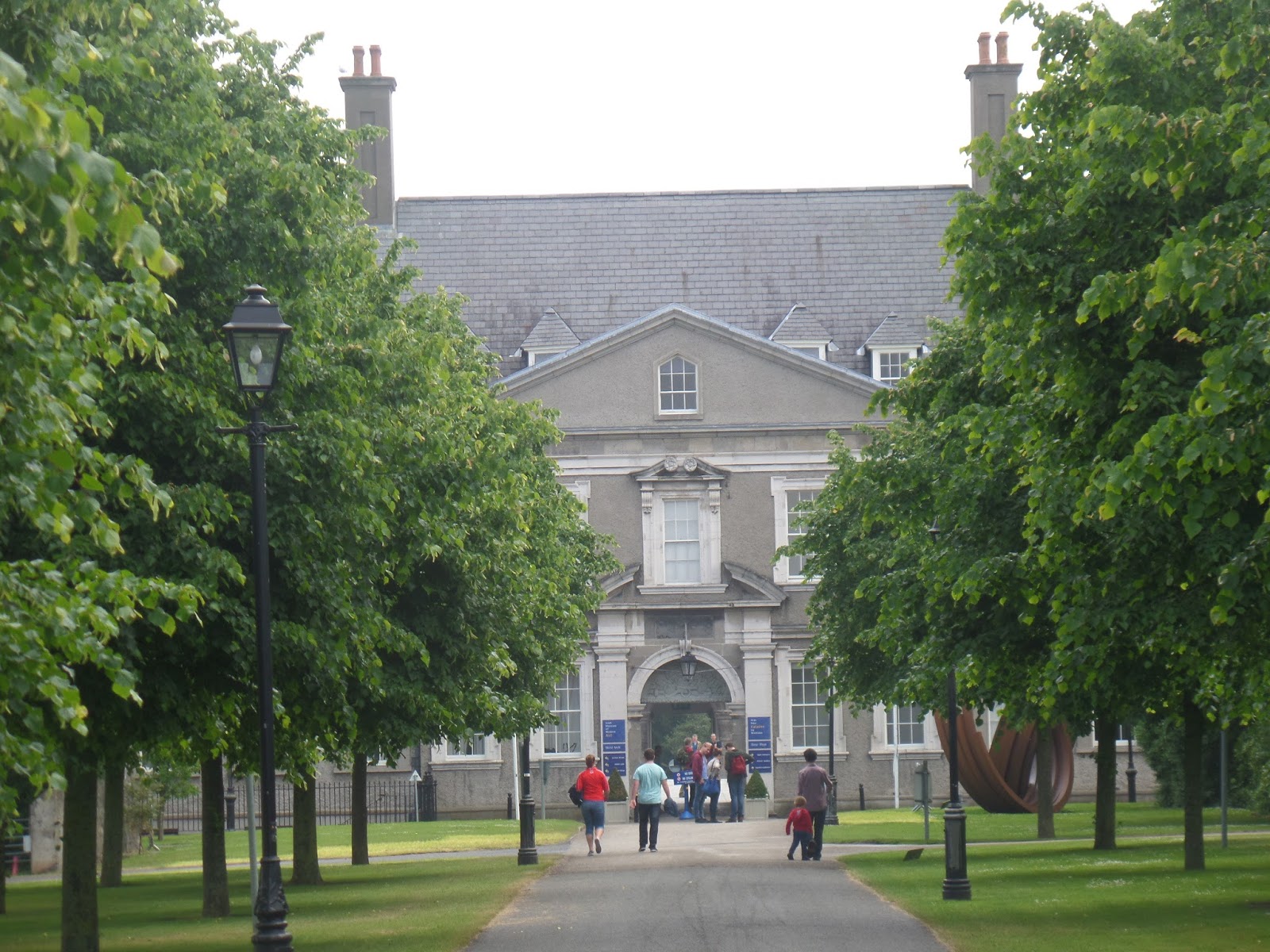
We then followed a lovely path through the Old Royal Hospital, which is now the Irish Museum of Modern Art.  The finding of this beautiful old building and the equally beautiful park was unexpected and became a highlight of our day.
The hospital built in 1684, was for retired soldiers.  There were also two graveyards in the park.  The buildings were restored by the Irish Government in 1984.

The chapel, in the photograph below, is now rented out for private functions.
The very long path on the other side led us towards Kilmainham Gaol.
There was a gatehouse at the end of the path, and once through it, we could see Kilmainham Gaol and Courthouse.
Kilmainham Gaol, beautifully restored, but not accessible to us, as we had not booked in advance.  There were only a few tickets left for late in the afternoon and we had no intention of waiting around that long.
We were able to look inside the courthouse, also beautifully restored.  The courthouse had been used until well into the 1990s.
The glass covering the stairs that led to the lock up for prisoners.  They stopped using this lockup due to prisoners making too much noise, and disturbing the court proceedings.  A new lockup was built beside the courthouse.
A beautiful set of stairs, and plenty of information about the courthouse for Walter to read.
We decided there and then that we would not visit the Guinness Factory, due to the high number of tourists around,  and would instead visit the National Museum of Ireland - Decorative Arts and History.  Much quieter, we thought.

So we retraced our steps through the old Royal Hospital, and then through the Heuston Railway Station, where we had had coffee earlier in the morning.  While we drank our coffee I chatted to a woman who was travelling to Knock, County Mayo, on the train.  She was such an interesting person.  I loved her story of travelling around the Ring of Kerry in a caravan towed by a horse.  Not a wise decision, she realised afterwards as caring for a horse proved to be quite difficult.

I have always intended to visit Knock, but it was too far north to go there on this visit.  Knock is a holy place, and similar to Lourdes and Fatima.  There is a shrine there.  Apparently the Virgin Mary, together with St Joseph and St John the Evangelist appeared there in August 1879.
We walked past the Croppies Memorial Park, and wondered about the unusual sculpture so looked it up later.  It is of Anna Livia and called 'The Floozie in the Jacuzzi'.   The sculpture, part of a fountain, used to be in O'Connell Street.  It was moved, due to the large amount of trash thrown into it, and the weekly addition of liquid soap added to it by drunken revellers, in order to provide plenty of bubbles.

The park was closed, as was the park up the street, in order to stop people sleeping rough, apparently.   Hopefully just closed on weekends as both parks were lovely.
The National Museum - Decorative Arts & History.  A very imposing building, built in 1702, and called The Royal Barracks.  It had a name change to Collins Barracks in 1922.  Michael Collins, the First Commander in Chief of the Free State, was killed that year.
We ate a delicious lunch in the cafe, mine a bree and chorizo salad, and Walter had a Thai chicken open sandwich, followed by coffee and cake.  Food is so good in Dublin.

After lunch we looked at the exhibition about the 1916 Rising, which gave more information than the exhibition in the GPO.  The detailed description of the last hours of each leader, plus special mementos they left to their families, was especially poignant.

The flag that was hung from the GPO during the rebellion.
We went our separate ways for the last hour.  Walter to the military exhibits and me to the top floor to see the clothes through the ages exhibits and most importantly to view the exhibition about Eileen Gray, 1878-1976.

Eileen Gray, who was born in Wexford, to a very wealthy family.  She went to art colleges in London and Paris and ended up working in Paris, I think.  She became an influential designer and architect.

Her furniture, in the photograph below was very simple and practical.
We finally caught a tram back to the centre of Dublin, and then a bus home.  Two very tired but happy people.

I love the green suit in Carrolls Irish Gift Shop.
Off to Limerick tomorrow.  Ever onwards.